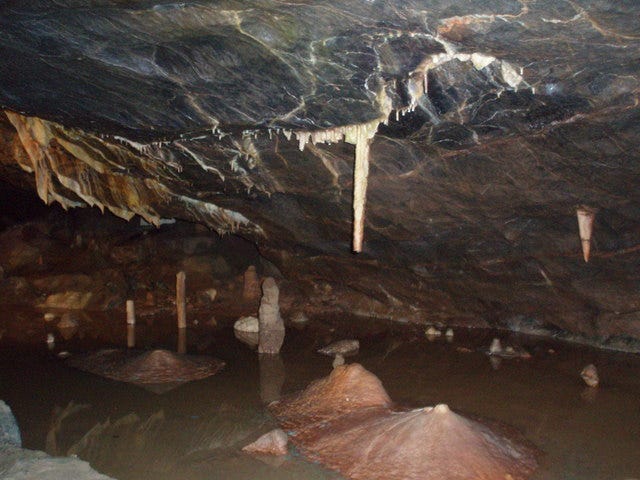
Stalactites
At around this time I had started to see Dad again. My brother was the catalyst. He came down to school and talked to me about it. He said it was time. I agreed. Had my views changed? Or did I just go along with it, in the same way I had gone along with not seeing him? Perhaps both.
My brother took me out from school one Sunday, and Dad came to meet me with my stepmother. He looked tireder, older and greyer. I felt a rush of sympathy and love for him and gave him a hug. I don’t remember what we did or where we went. After that, Dad would visit on every other Sunday.
I don’t remember how we told Mum either, or how she reacted, but I started not to tolerate the old dispensation. I gradually began to mention Dad and that I was spending time with him. I even mentioned my stepmother, whom Mum continued to call “his fancy woman”.
Her attitude to Dad changed over time, from blaming him to blaming herself. She never stopped thinking of herself as married to him in God’s eyes. When she died, there was a silver-framed photograph of him in the room. She also never forgave my stepmother: 30 years later, she ignored her absolutely at my brother’s wedding, when she stepped forward and tried to say hello. “Why can’t she just be reasonable?” my father would have said. He had spent his life getting along with people; his stories of other marriages and affairs would end triumphantly “and they all got along very nicely”.
My mother was unconcerned by safety. Sam the dog liked to put his head out of the window as we drove along. I also got a taste for this, and in country lanes, I would climb halfway out of the car window and perch on the door ledge, enjoying the sensation as hedges whizzed by and the high position looking over the car roof. If a friend was there we would both do it, one on each side.
She seemed fearless. We once took a guided tour through Cheddar Gorge. Wanting to get closer to the stalactites, she stepped over the rope. The guide started to tell her that it wasn’t allowed. She just shouted back “I want to see them close up”. “Some say there used to be dragons in these caves,” said the guide to the rest of the group, “and perhaps there’s one there now.” My conventional adolescent self was humiliated by this maternal misbehaviour. But I also felt pride. My mother knew what the guide did not, that rules were for breaking, and only applied if you let them. I knew it too, even though in practice I was very obedient, and frightened if I got into trouble with any adult. It was the same when we lit the candles on the Christmas tree and watched it, and our visitors — the bores! — made nervous health-and-safety jokes. Or later, when she went off to Pakistan to travel for months, and her lady friends were concerned for her safety. Why wouldn’t you go to Peshawar if you wanted to? Why should you come back just because they had flown two planes into the World Trade Center? Or when she drove very slowly through the shire with a trail of angry cars behind her. It never occurred to her to worry about what they thought. Whereas when cars come up behind me, I instinctively speed up so as to convenience them.
Still, she had never quite lived an unconventional life. It seemed that way, but it was just that her conventions had been set very early, and had not altered. She didn’t have a career, when her younger sisters somewhat did. She’d needed a husband in some way. After the time when John had followed her into town, she wrote in her diary that she would miss the garden of South Lodge, if she left him. But it was no nicer than the garden of the Stone House. What kept her there? Fear of a second failure?